Filters
Question type

Study Flashcards

At 450°C,tert-butyl alcohol decomposes into water and isobutene. (CH3) 3COH(g) At 450°C,tert-butyl alcohol decomposes into water and isobutene. (CH<sub>3</sub>) <sub>3</sub>COH(g)    (CH<sub>3</sub>) <sub>2</sub>CCH<sub>2</sub>(g) + H<sub>2</sub>O(g)  A reaction vessel contains these compounds at equilibrium.What will happen if the volume of the container is reduced by 50% at constant temperature? A) The forward reaction will proceed to reestablish equilibrium. B) The reverse reaction will proceed to reestablish equilibrium. C) No change occurs. D) The equilibrium constant will increase. E) The equilibrium constant will decrease. (CH3) 2CCH2(g) + H2O(g) A reaction vessel contains these compounds at equilibrium.What will happen if the volume of the container is reduced by 50% at constant temperature?


A) The forward reaction will proceed to reestablish equilibrium.
B) The reverse reaction will proceed to reestablish equilibrium.
C) No change occurs.
D) The equilibrium constant will increase.
E) The equilibrium constant will decrease.

F) None of the above
G) A) and E)

Correct Answer

verifed

verified

Consider the reversible reaction: 2NO2(g) Consider the reversible reaction: 2NO<sub>2</sub>(g)    N<sub>2</sub>O<sub>4</sub>(g)  If the concentrations of both NO<sub>2</sub> and N<sub>2</sub>O<sub>4</sub> are 0.016 mol L<sup>-1</sup>,what is the value of Q<sub>c</sub>? A) 0.016 B) 0.50 C) 1.0 D) 2.0 E) 63 N2O4(g) If the concentrations of both NO2 and N2O4 are 0.016 mol L-1,what is the value of Qc?


A) 0.016
B) 0.50
C) 1.0
D) 2.0
E) 63

F) None of the above
G) C) and D)

Correct Answer

verifed

verified

The following reaction is at equilibrium in a sealed container. The following reaction is at equilibrium in a sealed container.   Which,if any,of the following actions will increase the value of the equilibrium constant,K<sub>c</sub>? A) adding a catalyst B) adding more N<sub>2</sub> C) increasing the pressure D) lowering the temperature E) None of these choices is correct. Which,if any,of the following actions will increase the value of the equilibrium constant,Kc?


A) adding a catalyst
B) adding more N2
C) increasing the pressure
D) lowering the temperature
E) None of these choices is correct.

F) C) and D)
G) B) and E)

Correct Answer

verifed

verified

Nitrogen dioxide can dissociate to nitric oxide and oxygen. Nitrogen dioxide can dissociate to nitric oxide and oxygen.   Under which reaction conditions would you expect to produce the largest amount of oxygen? A) high temperature,high pressure B) low temperature,high pressure C) high temperature,low pressure D) low temperature,low pressure E) none of these,unless a catalyst is present Under which reaction conditions would you expect to produce the largest amount of oxygen?


A) high temperature,high pressure
B) low temperature,high pressure
C) high temperature,low pressure
D) low temperature,low pressure
E) none of these,unless a catalyst is present

F) A) and B)
G) A) and C)

Correct Answer

verifed

verified

The equilibrium constant,Kp ,for the reaction CO(g) + H2O(g) The equilibrium constant,K<sub>p</sub> ,for the reaction CO(g) + H<sub>2</sub>O(g)    CO<sub>2</sub>(g) + H<sub>2</sub>(g)  At 986°C is 0.63.A rigid cylinder at that temperature contains 1.2 atm of carbon monoxide,0.20 atm of water vapor,0.30 atm of carbon dioxide,and 0.27 atm of hydrogen.Is the system at equilibrium? A) Yes. B) No,the forward reaction must proceed to establish equilibrium. C) No,the reverse reaction must proceed to establish equilibrium. D) The volume of the container must be known before deciding. E) The starting concentrations of all substances must be known before deciding. CO2(g) + H2(g) At 986°C is 0.63.A rigid cylinder at that temperature contains 1.2 atm of carbon monoxide,0.20 atm of water vapor,0.30 atm of carbon dioxide,and 0.27 atm of hydrogen.Is the system at equilibrium?


A) Yes.
B) No,the forward reaction must proceed to establish equilibrium.
C) No,the reverse reaction must proceed to establish equilibrium.
D) The volume of the container must be known before deciding.
E) The starting concentrations of all substances must be known before deciding.

F) B) and E)
G) A) and B)

Correct Answer

verifed

verified

Write the mass-action expression,Qc,for the following chemical reaction. Fe3+(aq) + 3OH-(aq) Write the mass-action expression,Q<sub>c</sub>,for the following chemical reaction. Fe<sup>3+</sup>(aq) + 3OH<sup>-</sup>(aq)    Fe(OH) <sub>3</sub>(s)  A)    B)    C)    D)    E)   Fe(OH) 3(s)


A)
Write the mass-action expression,Q<sub>c</sub>,for the following chemical reaction. Fe<sup>3+</sup>(aq) + 3OH<sup>-</sup>(aq)    Fe(OH) <sub>3</sub>(s)  A)    B)    C)    D)    E)
B)
Write the mass-action expression,Q<sub>c</sub>,for the following chemical reaction. Fe<sup>3+</sup>(aq) + 3OH<sup>-</sup>(aq)    Fe(OH) <sub>3</sub>(s)  A)    B)    C)    D)    E)
C)
Write the mass-action expression,Q<sub>c</sub>,for the following chemical reaction. Fe<sup>3+</sup>(aq) + 3OH<sup>-</sup>(aq)    Fe(OH) <sub>3</sub>(s)  A)    B)    C)    D)    E)
D)
Write the mass-action expression,Q<sub>c</sub>,for the following chemical reaction. Fe<sup>3+</sup>(aq) + 3OH<sup>-</sup>(aq)    Fe(OH) <sub>3</sub>(s)  A)    B)    C)    D)    E)
E)
Write the mass-action expression,Q<sub>c</sub>,for the following chemical reaction. Fe<sup>3+</sup>(aq) + 3OH<sup>-</sup>(aq)    Fe(OH) <sub>3</sub>(s)  A)    B)    C)    D)    E)

F) B) and E)
G) A) and C)

Correct Answer

verifed

verified

The equilibrium constant for reaction (1) below is 276.Under the same conditions,what is the equilibrium constant of reaction (2) ? (1)  The equilibrium constant for reaction (1) below is 276.Under the same conditions,what is the equilibrium constant of reaction (2) ? (1)    X<sub>2</sub>(g) +   Y<sub>2</sub>(g)    XY(g)  (2) 2XY(g)    X<sub>2</sub>(g) + Y<sub>2</sub>(g)  A) 6.02  \times  10<sup>-2</sup> B) 7.25  \times  10<sup>-3</sup> C) 3.62  \times  10<sup>-3</sup> D) 1.31  \times  10<sup>-5</sup> E) None of these choices is correct. X2(g) +  The equilibrium constant for reaction (1) below is 276.Under the same conditions,what is the equilibrium constant of reaction (2) ? (1)    X<sub>2</sub>(g) +   Y<sub>2</sub>(g)    XY(g)  (2) 2XY(g)    X<sub>2</sub>(g) + Y<sub>2</sub>(g)  A) 6.02  \times  10<sup>-2</sup> B) 7.25  \times  10<sup>-3</sup> C) 3.62  \times  10<sup>-3</sup> D) 1.31  \times  10<sup>-5</sup> E) None of these choices is correct. Y2(g)  The equilibrium constant for reaction (1) below is 276.Under the same conditions,what is the equilibrium constant of reaction (2) ? (1)    X<sub>2</sub>(g) +   Y<sub>2</sub>(g)    XY(g)  (2) 2XY(g)    X<sub>2</sub>(g) + Y<sub>2</sub>(g)  A) 6.02  \times  10<sup>-2</sup> B) 7.25  \times  10<sup>-3</sup> C) 3.62  \times  10<sup>-3</sup> D) 1.31  \times  10<sup>-5</sup> E) None of these choices is correct. XY(g) (2) 2XY(g)  The equilibrium constant for reaction (1) below is 276.Under the same conditions,what is the equilibrium constant of reaction (2) ? (1)    X<sub>2</sub>(g) +   Y<sub>2</sub>(g)    XY(g)  (2) 2XY(g)    X<sub>2</sub>(g) + Y<sub>2</sub>(g)  A) 6.02  \times  10<sup>-2</sup> B) 7.25  \times  10<sup>-3</sup> C) 3.62  \times  10<sup>-3</sup> D) 1.31  \times  10<sup>-5</sup> E) None of these choices is correct. X2(g) + Y2(g)


A) 6.02 ×\times 10-2
B) 7.25 ×\times 10-3
C) 3.62 ×\times 10-3
D) 1.31 ×\times 10-5
E) None of these choices is correct.

F) A) and B)
G) A) and D)

Correct Answer

verifed

verified

The reaction of nitric oxide to form dinitrogen oxide and nitrogen dioxide is exothermic. 3NO(g) The reaction of nitric oxide to form dinitrogen oxide and nitrogen dioxide is exothermic. 3NO(g)    N<sub>2</sub>O(g) + NO<sub>2</sub>(g) + heat What effect will be seen if the temperature of the system at equilibrium is raised by 25°C? A) The partial pressure of NO will increase. B) The partial pressure of NO will decrease. C) The partial pressure of NO<sub>2</sub> will increase. D) The partial pressures of NO and N<sub>2</sub>O will increase. E) All three partial pressures will increase. N2O(g) + NO2(g) + heat What effect will be seen if the temperature of the system at equilibrium is raised by 25°C?


A) The partial pressure of NO will increase.
B) The partial pressure of NO will decrease.
C) The partial pressure of NO2 will increase.
D) The partial pressures of NO and N2O will increase.
E) All three partial pressures will increase.

F) A) and E)
G) None of the above

Correct Answer

verifed

verified

Consider the following two equilibria and their respective equilibrium constants: (1) NO(g) + Consider the following two equilibria and their respective equilibrium constants: (1) NO(g) +   O<sub>2</sub>(g)    NO<sub>2</sub>(g)  (2) 2NO<sub>2</sub>(g)    2NO(g) + O<sub>2</sub>(g)  Which one of the following is the correct relationship between the equilibrium constants K<sub>1</sub> and K<sub>2</sub>? A) K<sub>2</sub> = 2/K<sub>1</sub> B) K<sub>2</sub> = (1/K<sub>1</sub>) <sup>2</sup> C) K<sub>2</sub> = -K<sub>1</sub>/2 D) K<sub>2</sub> = 1/(2K<sub>1</sub>)  E) K<sub>2</sub> = 1/(2K<sub>1</sub>) <sup>2</sup> O2(g) Consider the following two equilibria and their respective equilibrium constants: (1) NO(g) +   O<sub>2</sub>(g)    NO<sub>2</sub>(g)  (2) 2NO<sub>2</sub>(g)    2NO(g) + O<sub>2</sub>(g)  Which one of the following is the correct relationship between the equilibrium constants K<sub>1</sub> and K<sub>2</sub>? A) K<sub>2</sub> = 2/K<sub>1</sub> B) K<sub>2</sub> = (1/K<sub>1</sub>) <sup>2</sup> C) K<sub>2</sub> = -K<sub>1</sub>/2 D) K<sub>2</sub> = 1/(2K<sub>1</sub>)  E) K<sub>2</sub> = 1/(2K<sub>1</sub>) <sup>2</sup> NO2(g) (2) 2NO2(g) Consider the following two equilibria and their respective equilibrium constants: (1) NO(g) +   O<sub>2</sub>(g)    NO<sub>2</sub>(g)  (2) 2NO<sub>2</sub>(g)    2NO(g) + O<sub>2</sub>(g)  Which one of the following is the correct relationship between the equilibrium constants K<sub>1</sub> and K<sub>2</sub>? A) K<sub>2</sub> = 2/K<sub>1</sub> B) K<sub>2</sub> = (1/K<sub>1</sub>) <sup>2</sup> C) K<sub>2</sub> = -K<sub>1</sub>/2 D) K<sub>2</sub> = 1/(2K<sub>1</sub>)  E) K<sub>2</sub> = 1/(2K<sub>1</sub>) <sup>2</sup> 2NO(g) + O2(g) Which one of the following is the correct relationship between the equilibrium constants K1 and K2?


A) K2 = 2/K1
B) K2 = (1/K1) 2
C) K2 = -K1/2
D) K2 = 1/(2K1)
E) K2 = 1/(2K1) 2

F) A) and C)
G) A) and D)

Correct Answer

verifed

verified

In order to write the correct mass-action expression for a reaction one must


A) know the kinetic rate law for the reaction.
B) know the mechanism for the reaction.
C) have a properly balanced chemical equation.
D) have values for the concentrations of the reactants.
E) know the limiting reactant.

F) B) and C)
G) A) and D)

Correct Answer

verifed

verified

For some gas-phase reactions,Kp = Kc.

A) True
B) False

Correct Answer

verifed

verified

Write the mass-action expression,Qc,for the following chemical reaction. 3ClO2-(aq) Write the mass-action expression,Q<sub>c</sub>,for the following chemical reaction. 3ClO<sub>2</sub><sup>-</sup>(aq)    2ClO<sub>3</sub><sup>-</sup>(aq) + Cl<sup>-</sup>(aq)  A)    B)    C)    D)    E)   2ClO3-(aq) + Cl-(aq)


A)
Write the mass-action expression,Q<sub>c</sub>,for the following chemical reaction. 3ClO<sub>2</sub><sup>-</sup>(aq)    2ClO<sub>3</sub><sup>-</sup>(aq) + Cl<sup>-</sup>(aq)  A)    B)    C)    D)    E)
B)
Write the mass-action expression,Q<sub>c</sub>,for the following chemical reaction. 3ClO<sub>2</sub><sup>-</sup>(aq)    2ClO<sub>3</sub><sup>-</sup>(aq) + Cl<sup>-</sup>(aq)  A)    B)    C)    D)    E)
C)
Write the mass-action expression,Q<sub>c</sub>,for the following chemical reaction. 3ClO<sub>2</sub><sup>-</sup>(aq)    2ClO<sub>3</sub><sup>-</sup>(aq) + Cl<sup>-</sup>(aq)  A)    B)    C)    D)    E)
D)
Write the mass-action expression,Q<sub>c</sub>,for the following chemical reaction. 3ClO<sub>2</sub><sup>-</sup>(aq)    2ClO<sub>3</sub><sup>-</sup>(aq) + Cl<sup>-</sup>(aq)  A)    B)    C)    D)    E)
E)
Write the mass-action expression,Q<sub>c</sub>,for the following chemical reaction. 3ClO<sub>2</sub><sup>-</sup>(aq)    2ClO<sub>3</sub><sup>-</sup>(aq) + Cl<sup>-</sup>(aq)  A)    B)    C)    D)    E)

F) B) and C)
G) A) and E)

Correct Answer

verifed

verified

Magnesium carbonate dissociates to magnesium oxide and carbon dioxide at elevated temperatures. MgCO3(s) Magnesium carbonate dissociates to magnesium oxide and carbon dioxide at elevated temperatures. MgCO<sub>3</sub>(s)    MgO(s) + CO<sub>2</sub>(g)  A reaction vessel contains these compounds in equilibrium at 300°C.What will happen if the volume of the container is reduced by 25% at 300°C? A) The partial pressure of carbon dioxide present at equilibrium will increase. B) The partial pressure of carbon dioxide present at equilibrium will decrease. C) The partial pressure of carbon dioxide at equilibrium will be unchanged. D) The equilibrium constant will have to decrease to compensate for the decrease in volume. E) More information is needed in order to make a valid judgment. MgO(s) + CO2(g) A reaction vessel contains these compounds in equilibrium at 300°C.What will happen if the volume of the container is reduced by 25% at 300°C?


A) The partial pressure of carbon dioxide present at equilibrium will increase.
B) The partial pressure of carbon dioxide present at equilibrium will decrease.
C) The partial pressure of carbon dioxide at equilibrium will be unchanged.
D) The equilibrium constant will have to decrease to compensate for the decrease in volume.
E) More information is needed in order to make a valid judgment.

F) C) and E)
G) A) and E)

Correct Answer

verifed

verified

A container was charged with hydrogen,nitrogen,and ammonia gases at 120°C and the system was allowed to reach equilibrium.What will happen if the volume of the container is increased at constant temperature? 3H2(g) + N2(g) A container was charged with hydrogen,nitrogen,and ammonia gases at 120°C and the system was allowed to reach equilibrium.What will happen if the volume of the container is increased at constant temperature? 3H<sub>2</sub>(g) + N<sub>2</sub>(g)    2NH<sub>3</sub>(g)  A) There will be no effect. B) More ammonia will be produced at the expense of hydrogen and nitrogen. C) Hydrogen and nitrogen will be produced at the expense of ammonia. D) The equilibrium constant will increase. E) The equilibrium constant will decrease. 2NH3(g)


A) There will be no effect.
B) More ammonia will be produced at the expense of hydrogen and nitrogen.
C) Hydrogen and nitrogen will be produced at the expense of ammonia.
D) The equilibrium constant will increase.
E) The equilibrium constant will decrease.

F) B) and E)
G) B) and D)

Correct Answer

verifed

verified

The reaction system POCl3(g) The reaction system POCl<sub>3</sub>(g)    POCl(g) + Cl<sub>2</sub>(g)  Is at equilibrium.Which of the following statements describes the behavior of the system if POCl is added to the container? A) The forward reaction will proceed to establish equilibrium. B) The reverse reaction will proceed to establish equilibrium. C) The partial pressures of POCl<sub>3</sub> and POCl will remain steady while the partial pressure of chlorine increases. D) The partial pressure of chlorine remains steady while the partial pressures of POCl<sub>3</sub> and POCl increase. E) The partial pressure of chlorine will increase while the partial pressure of POCl decreases. POCl(g) + Cl2(g) Is at equilibrium.Which of the following statements describes the behavior of the system if POCl is added to the container?


A) The forward reaction will proceed to establish equilibrium.
B) The reverse reaction will proceed to establish equilibrium.
C) The partial pressures of POCl3 and POCl will remain steady while the partial pressure of chlorine increases.
D) The partial pressure of chlorine remains steady while the partial pressures of POCl3 and POCl increase.
E) The partial pressure of chlorine will increase while the partial pressure of POCl decreases.

F) A) and D)
G) A) and C)

Correct Answer

verifed

verified

Changing the amount of reactant or product in an equilibrium reaction will always change the equilibrium position,regardless of the physical state of the substance involved.

A) True
B) False

Correct Answer

verifed

verified

There is a direct correlation between the speed of a reaction and its equilibrium constant.

A) True
B) False

Correct Answer

verifed

verified

Consider the equilibrium H2(g)+ Br2(g) Consider the equilibrium H<sub>2</sub>(g)+ Br<sub>2</sub>(g)    2HBr(g) To a 20.0 L flask are added 0.100 moles of H<sub>2</sub> and 0.200 moles of HBr.The equilibrium constant for this reaction is 989.Calculate the number of moles of Br<sub>2</sub> in the flask when equilibrium is established.Make any reasonable approximation,clearly stating what that approximation is. 2HBr(g) To a 20.0 L flask are added 0.100 moles of H2 and 0.200 moles of HBr.The equilibrium constant for this reaction is 989.Calculate the number of moles of Br2 in the flask when equilibrium is established.Make any reasonable approximation,clearly stating what that approximation is.

Correct Answer

verifed

verified

~ 4.0 blured image 10-4 mol of ...

View Answer

Ammonium iodide dissociates reversibly to ammonia and hydrogen iodide. NH4I(s) Ammonium iodide dissociates reversibly to ammonia and hydrogen iodide. NH<sub>4</sub>I(s)    NH<sub>3</sub>(g) + HI(g)  At 400°C,K<sub>p</sub> = 0.215.Calculate the partial pressure of ammonia at equilibrium when a sufficient quantity of ammonium iodide is heated to 400°C. A) 0.103 atm B) 0.215 atm C) 0.232 atm D) 0.464 atm E) 2.00 atm NH3(g) + HI(g) At 400°C,Kp = 0.215.Calculate the partial pressure of ammonia at equilibrium when a sufficient quantity of ammonium iodide is heated to 400°C.


A) 0.103 atm
B) 0.215 atm
C) 0.232 atm
D) 0.464 atm
E) 2.00 atm

F) A) and E)
G) A) and B)

Correct Answer

verifed

verified

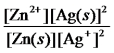
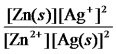
Write the mass-action expression,Qc,for the following chemical reaction. Zn(s) + 2Ag+(aq) Write the mass-action expression,Q<sub>c</sub>,for the following chemical reaction. Zn(s) + 2Ag<sup>+</sup>(aq)    Zn<sup>2+</sup>(aq) + 2Ag(s)  A)    B)    C)    D)    E)   Zn2+(aq) + 2Ag(s)


A)
Write the mass-action expression,Q<sub>c</sub>,for the following chemical reaction. Zn(s) + 2Ag<sup>+</sup>(aq)    Zn<sup>2+</sup>(aq) + 2Ag(s)  A)    B)    C)    D)    E)
B)
Write the mass-action expression,Q<sub>c</sub>,for the following chemical reaction. Zn(s) + 2Ag<sup>+</sup>(aq)    Zn<sup>2+</sup>(aq) + 2Ag(s)  A)    B)    C)    D)    E)
C)
Write the mass-action expression,Q<sub>c</sub>,for the following chemical reaction. Zn(s) + 2Ag<sup>+</sup>(aq)    Zn<sup>2+</sup>(aq) + 2Ag(s)  A)    B)    C)    D)    E)
D)
Write the mass-action expression,Q<sub>c</sub>,for the following chemical reaction. Zn(s) + 2Ag<sup>+</sup>(aq)    Zn<sup>2+</sup>(aq) + 2Ag(s)  A)    B)    C)    D)    E)
E)
Write the mass-action expression,Q<sub>c</sub>,for the following chemical reaction. Zn(s) + 2Ag<sup>+</sup>(aq)    Zn<sup>2+</sup>(aq) + 2Ag(s)  A)    B)    C)    D)    E)

F) B) and D)
G) A) and B)

Correct Answer

verifed

verified

Showing 41 - 60 of 85

Related Exams

Show Answer